


 Close Menu
 World
World
 Biography
 Health
 Education
 Business
 Lifestyle
 Sports
 Technology
 Animals
 History
 Food
Food
 Religious
 Startups
 Movies
 Politics
 Fashion
 Covid
Covid
 Diet
Diet
 Fitness
 Marketing
 Travel
 Science
 Reviews
 Social media
 Stories
 Facts
Facts
 Art
Art
 Entertainment
Ai agent
Marketing
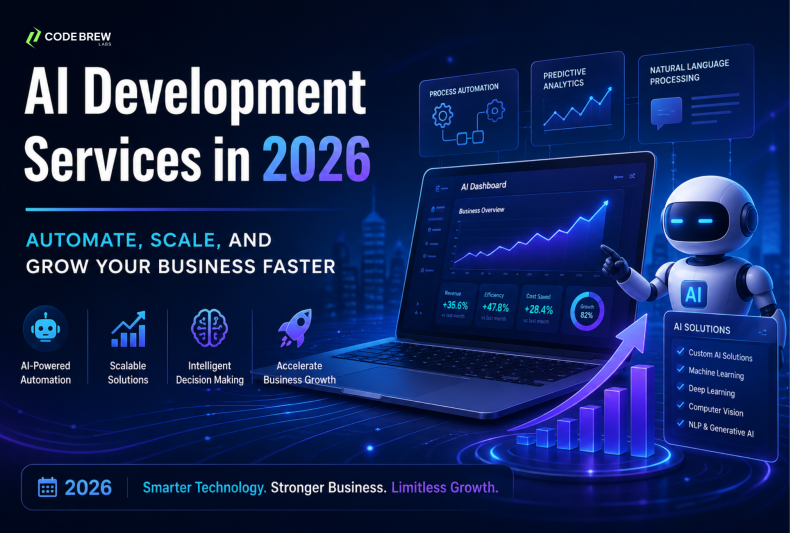
AI Development Services in 2026: Automate, Scale, and Grow Your Business Faster
 Ai agent
Artificial intelligence has transitioned from experimentation to practical application. In 2026, businesses are no longer questioning whether they should adopt AI; instead, they are focused on how to implement it effectively to achieve measurable outcomes.
The challenge isn't access to models or tools; the real issue lies in how AI systems are built, deployed, and maintained over time. Many organizations still view AI as a feature rather than as a foundational infrastructure. This perspective can result in fragmented implementations, unreliable outputs, and costly cycles of rebuilding.
In 2026, AI development services are evolving beyond mere model creation. They now emphasize building production-grade systems that are deeply integrated into business operations and can scale with growing demand.
The Shift from AI Features to AI Infrastructure
A common mistake companies make is treating AI as an add-on capability. They integrate a chatbot, a recommendation engine, or a predictive model without addressing the underlying architecture.
This approach often works in early stages but fails under real-world conditions. Data pipelines break. Models drift. Performance degrades.
Modern AI development services take a fundamentally different approach. They focus on:
- Clean and structured data pipelines
- Scalable cloud-native architecture
- Continuous monitoring and model retraining
- Seamless integration with existing enterprise systems
This shift from feature-based thinking to infrastructure-driven execution is what separates experimental AI from production AI.
What AI Development Services Actually Include in 2026
AI development is no longer limited to building algorithms. It now covers the entire lifecycle of intelligent systems.
1. Data Engineering and Pipeline Design
AI systems are only as reliable as the data they consume. High-quality AI services begin with designing robust pipelines that collect, clean, and process data in real time.
Without this foundation, even the most advanced models fail to deliver consistent results.
2. Custom Model Development and Integration
Instead of relying solely on off-the-shelf models, companies are investing in tailored AI systems aligned with their business logic.
This includes:
- Predictive analytics models
- Generative AI systems
- Automation engines
- Decision intelligence frameworks
The focus is on alignment with business outcomes rather than technical novelty.
3. Scalable Architecture Design
AI systems must handle increasing data loads, user traffic, and operational complexity.
This requires:
- Distributed computing frameworks
- Microservices architecture
- Cloud-native deployment strategies
Scalability is not an afterthought. It is designed from the beginning.
4. Monitoring, Optimization, and Model Lifecycle Management
One of the most overlooked aspects of AI is post-deployment performance.
Models degrade over time due to changing data patterns. Without monitoring systems in place, accuracy drops and decisions become unreliable.
Modern AI services include:
- Model performance tracking
- Drift detection
- Automated retraining pipelines
- Continuous optimization
This ensures long-term stability and ROI.
The Role of a Production-First AI Development Partner
This is where the role of an AI development company becomes critical. Not all vendors operate at the same level.
A production-first partner focuses on building systems that:
- Operate reliably in real-world environments
- Scale with business growth
- Integrate with enterprise ecosystems
- Deliver measurable performance improvements
Code Brew Labs exemplifies this approach. With over 13 years of experience in technology and 4 years focused specifically on AI, the company has transformed more than 2,600 business ventures and engineered 25+ enterprise-grade AI solutions. Their ecosystem includes 50+ Fortune 100 technology partnerships, enabling them to build systems that are both scalable and enterprise-ready.
Their approach is not centered on rapid prototyping. Instead, they focus on:
- Architecture-first AI system design
- Clean and reliable data engineering
- Cloud-native scalability
- Continuous monitoring and lifecycle optimization
This ensures that AI implementations are not just deployed but sustained and improved over time.
Industry Applications Driving AI Adoption
AI development services are now deeply embedded across industries, each with its own priorities.
Fintech
Security and compliance are central. AI is used for fraud detection, transaction monitoring, and risk assessment. Systems must be highly reliable and auditable.
Healthcare
Data governance and privacy are critical. AI supports diagnostics, predictive patient care, and operational efficiency while maintaining strict regulatory compliance.
Hospitality
Personalization and operational intelligence are key. AI enhances customer experiences while improving backend efficiency.
Enterprise Operations
Large organizations use AI to streamline workflows, improve decision-making, and enhance scalability across departments.
In all cases, the effectiveness of AI depends on how well it is integrated into core systems rather than isolated use cases.
The Future of AI Development Services
AI in 2026 is moving toward deeper integration, not broader experimentation.
The next phase will focus on:
- Autonomous systems that require minimal manual intervention
- Real-time decision intelligence
- Fully integrated enterprise AI ecosystems
- Continuous learning systems that evolve with business needs
Companies that invest in scalable architecture today will be better positioned to adapt to these advancements.
Conclusion
In 2026, AI development services focus on execution rather than experimentation. Companies that are experiencing genuine growth are those that create AI systems with a long-term vision. These organizations prioritize infrastructure, scalability, and ongoing optimization instead of seeking quick, short-term gains.
Partnering with a production-focused company like Code Brew Labs allows businesses to move beyond disjointed AI projects and develop systems that provide lasting value. As competition grows fiercer, the true advantage will not come from being the first to adopt AI, but from building it correctly.
Source:
Click for the: Full Story
You might like